Analysis/ObsCast
Real-timeAI data assimilation that initializes models any time from fresh observations
outperformed NWP benchmarks in the first 12–18 hours

Microsoft Weather has been pioneering AI-powered weather forecasting for years. Our deep experience developing AI models and delivering weather at global scale is the foundation for a new generation of forecasting, powering Microsoft experiences and helping enterprises turn weather intelligence into better decisions.

Most accurate global forecast provider, 2022–2024, and for days 1–7 through 2025.
ForecastWatch
Average lower error with GridHD + PointCast's wind is as accurate at day 6 as ECMWF is at day 1.
GridHD EU regional + Pointcast Asset Model
In the first two seasons of the 2026 AI Weather Quest for subseasonal forecasts and leading in the AINPP nowcast competition.
ECMWF & WMO
Devices served by our forecasts in Windows, Bing, Copilot, and more, for over 8 years.
Mature Pipelines and Enterprise Grade
Our approach
We run a complete portfolio spanning every horizon, so each customer need can be solved by applying the right model to the decision in front of them — fit for purpose in resolution, frequency, cost, and value.
From the next five minutes to the next six weeks · an integrated portfolio, all Azure-native and runnable in your own tenant.*
AI data assimilation that initializes models any time from fresh observations
outperformed NWP benchmarks in the first 12–18 hours
hyperlocal precipitation in 4–10 minute steps out to 4 hours
leads the WMO AINPP nowcast competition · 1–2 km · 46 markets
high-definition regional forecasts at 2–5 km, hourly refresh out to 24–48 hours
outperforms all regional NWP on surface variables
station-tuned forecasts for your exact assets, 130,000+ locations
#1 ForecastWatch three years running · 20TB+ daily
deterministic and ensemble forecasts, 22 new variables, hourly steps, 48 members out 15 days
Outperforms ECMWF IFS ensemble on 89% of measured targets
30-day ensemble outlooks with daily-confidence guidance
superior track metrics across major multi-system ensembles
6-week subseasonal guidance for planning and trading
won the 2026 ECMWF Subseasonal AI Weather Quest
an always-on agentic decision-support solution
1st in the industry · shipped January 2026 · 98% responsible-AI success rate
*Not all models available yet for customer use
Aurora is a 1.3-billion-parameter foundation model of the Earth system, published in Nature in 2025 and released as open source. Available today in Azure AI Foundry, its capabilities span weather, ocean waves, air quality, and cyclone tracking. Released in September 2026, Aurora 1.5 builds on this foundation with ensemble forecasting, hourly resolution, and 22 new variables.
Published in Nature (2025) · 1.3B parameters, 0.1° resolution · Open source in Azure AI Foundry
Customer success
BKW, a leading Swiss energy company, needed to plan renewable generation and grid operations against volatile weather. We applied the right models from our portfolio — tuning Aurora and operational GridHD to their operations — helping their teams make earlier, more confident decisions.
Longer lead time, more confident decisions
Read more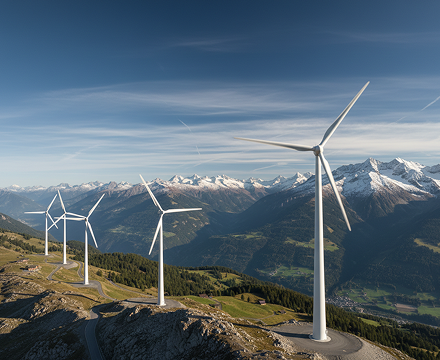

Photo by İsmail Enes Ayhan on Unsplash
Customer success
Data-center operations teams across the Southeast U.S. needed real-time and forecast weather intelligence for safety, cooling optimization, and business continuity. Microsoft Weather datasets were integrated through an MCP server and combined with operational data to power a custom, always-on agentic solution.
24/7 dashboards, daily briefings, alerts, resiliency triggers, and 72-hour outlooks
Custom integration · Shipped November 2025
"This collaboration demonstrates how advanced AI capabilities and robust cloud infrastructure can be applied to one of the most strategic domains — energy, where weather plays a fundamental role. In a time of accelerated transformation, it supports our ambition to operate increasingly renewable-based systems, where generation is inherently weather-dependent, and to better anticipate and manage this variability with greater confidence and precision."
Farhat Quiñones Yamshid
AI and Technology, BKW
"Microsoft's Aurora model is an exciting and promising tool, enabling Met Office scientists to bring their data and expertise to help solve climate problems and provide new kinds of climate information. Aurora is a great platform for learning how to translate these tools for use in climate projection to make the AI climate models of the future."
Doug McNeall
Science Lead for Data-Driven Climate Modelling, Met Office Hadley Centre
Independently verified and peer-reviewed · example results from across our model portfolio.
~5,000x
faster than traditional NWP (Aurora)
+89%
of measured targets outperformed (ECMWF IFS ensemble)
7
operational centers beaten on tropical-cyclone track accuracy (Aurora)
Hourly Wind
+24%
MAE err
Hourly Temp
+24%
MAE err
Hourly Precip
+44%
Brier off
Hourly Cloud
+14%
Brier off
Daily Wind
+38%
MAE err
Daily Temp
+35%
MAE err
Daily Precip
+56%
Brier off
Daily Cloud
+20%
Brier off
PointCast vs ECMWF IFS · Spring 2026 (March–May) · 1–9 day forecasts · 2,000 global stations
PointCast study integrated customer station data to achieve >15% additional accuracy!
EU 48-hour model: mean RMSE over all 0–48 h leads, each variable compared to the strongest non-GridHD baseline.
Temperature
34% lower RMSE
Dew point
15% lower RMSE
Specific humidity
13% lower RMSE
U-wind
20% lower RMSE
V-wind
21% lower RMSE
Wind speed
32% lower RMSE
Pressure
17% lower RMSE
The largest gains are in terrain-sensitive variables — temperature, dew point, and wind — which directly affect solar generation, wind forecasting, grid load, and operational risk windows.
Microsoft AI · July 2026
Yes. Our evaluations show that modern AI weather models consistently deliver forecast skill that is competitive with, and often exceeds, established industry benchmarks. Across a wide range of variables, locations, and forecast lead times, AI-based forecasting has demonstrated strong accuracy while also providing significant advantages in speed, scalability, and operational efficiency.
Yes. Our analysis demonstrates that AI weather models effectively forecast a wide range of extreme weather events. While extreme events are inherently difficult forecasting problems, we have found that AI models retain strong predictive skill during high-impact conditions and are capable of identifying the signals associated with significant weather events. The results show that AI models are not limited to forecasting average conditions and can be confidently applied to operational decision-making during periods of elevated weather risk.
Yes. Our evaluations show that AI weather models can successfully capture rapidly changing weather conditions, including wind ramps, cloud transitions, temperature shifts, and other events that are critical to energy and operational planning. Contrary to the perception that AI models smooth or miss abrupt changes, our results demonstrate that these models can detect and forecast ramp events with high skill, making them well suited for customers whose operations are sensitive to short-term weather variability.
Yes. Our tropical cyclone evaluations show that AI weather models can effectively forecast hurricanes and typhoons across multiple forecast horizons. The models consistently capture storm track evolution and key intensity characteristics with a level of accuracy that supports operational forecasting and risk-management workflows. These results reinforce our confidence that AI-based forecasting is a credible and effective approach for some of the most complex and impactful weather events on Earth.
Ensemble forecasting, hourly resolution, and 22 new variables — and how to run it.
Read moreIndependent verification confirms world-leading forecast accuracy across all major parameters.
Read moreHyperlocal precipitation forecasting with improved resolution and extended lead times.
Read moreThree ways to get started.
Request a capabilities briefing or a sample data feed for your geography and use case.
Access our AI weather models or build a custom solution — run them in your own Azure tenant.
Explore joint solution development that combines your domain expertise with our AI weather platform.